3 Best Eco Friendly Packaging Design Companies for Cosmetics and Skincare Brands
The beauty industry produces about 120 billion pieces of packaging each year—most never reach a recycling bin, according to Marie Claire. That mountain of waste now meets tighter sustainability rules and shoppers who judge a brand by its bottle.
If you run a skincare or makeup line, choosing a sustainable packaging partner is as strategic as picking a lab or retailer. You need design flair, verified green credentials, and timelines that won’t derail a launch.
In this guide, we rank the three suppliers that deliver on all three counts—and show exactly how we built the list.
Why sustainable packaging matters for cosmetics brands

Shifting consumer and legal pressure
Shoppers are rewriting the rules of beauty. A 2024 Nielsen report shows that 73 percent of global consumers are ready to change their buying habits to reduce environmental impact. In practice, they scan packaging before reading an ingredient list. If your jar or compact looks waste-heavy, many customers will scroll past without a second thought.
Regulators are moving just as quickly. The European Union’s Packaging and Packaging Waste Regulation requires every piece of packaging on the market to be economically recyclable by 2030. Similar plastic-tax bills and extended-producer-responsibility fees are advancing through state legislatures in the United States.
Put bluntly, if you ignore sustainability, you face a double hit: lost shoppers today and non-compliant products tomorrow.
How we chose the top 3 companies
Our evaluation criteria
We didn’t pull names from a hat. Instead, we built a six-point rubric that mirrors the challenges you face with every launch, from sustainability proof to minimum order limits.
First, every contender had to clear one basic hurdle: verifiable third-party certifications. If a supplier cannot back its green claims with credentials such as FSC, B Corp, or ISO 14001, we stop reading. According to Topfeelpack’s 2025 compliance guide, “Without third-party verification, it’s just talk.”
After that filter, we scored each company 1 to 5 on six factors:
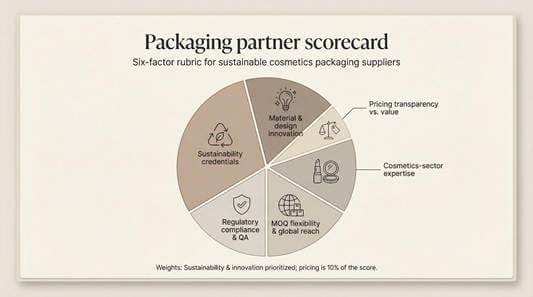
- Sustainability credentials
- Material and design innovation
- Cosmetics-sector expertise
- MOQ flexibility and global reach
- Regulatory compliance and quality assurance
- Pricing transparency versus value
Each factor carries a weight that reflects its real-world impact (sustainability and innovation lead at 25 percent each; pricing rounds out at 10 percent). Ties go to the supplier that serves indie brands best, because smaller runs are booming in 2026’s beauty scene.
The result is a data-driven ranking you can trust, not a popularity contest.
1. Zenpack – the end-to-end partner for agile, plastic-light beauty launches
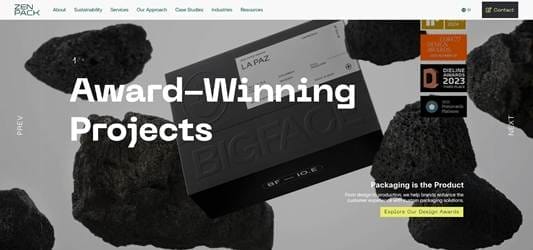
Zenpack sustainable beauty packaging design website screenshot
Zenpack starts where your mood board ends. Share the aesthetic, and their California design studio drafts structure, graphics, and supply-chain logistics in one sweep. Because engineers, designers, and freight planners sit at the same table, dielines stay elegant yet manufacturable, and excess transit miles get trimmed before anyone orders tooling.
Speed is their calling card. Clients often receive a white mock-up within days, a “golden” prototype about two weeks later, and finished pieces that match the sample down to the millimeter. That tempo is priceless when you are racing an influencer drop or a seasonal retailer window.
Awards back the craft. In 2024, Zenpack collected multiple iF Design honors, including a Gold for its BIGFACE coffee packaging, showing it can deliver intricate, premium structures without plastic clips or inserts.
Eco credentials run just as deep at zenpack.us, where FSC-certified boards are the default spec. Cushioning swaps petroleum foam for molded pulp or other plant-based materials, and when plastic is unavoidable, the team reaches for high-value resins like PET or HDPE and adds clear disposal instructions on pack.
Flexibility seals the deal. Need 500 influencer kits or 50 000 shelf-ready cartons? You keep the same project manager, the same color targets, and the same audit trail, with only the print run changing. That balance of boutique attention and scalable muscle is hard to find.
Who should call them first? Indie and mid-tier beauty brands that crave a bespoke unboxing experience, low MOQs, and evidence their packaging will not linger in landfill.
2. Albéa – global horsepower with auditable green metrics
Albéa is the packaging giant most beauty shoppers have never heard of, yet its mascara wands and lipstick bullets sit on vanities from Seoul to São Paulo. Thirty-five factories across 14 countries give the company a reach few rivals can match, so you can launch the same shade family in Paris and Los Angeles without juggling multiple suppliers.
Scale is only half the story. Albéa cut operational carbon 55 percent versus its 2019 baseline and, as of 2025, holds an EcoVadis Gold rating, placing it in the top three percent worldwide for corporate social responsibility. That audited data becomes your marketing proof the moment you sign a purchase order.
Research and development keep the catalog fresh. Engineers file about 20 new patents each year, with recent hits like Endless Kiss, a mono-material lipstick that drops straight into existing recycling streams, and Twirl, a refillable glass-and-polymer jar that snaps apart for easy cleaning. These items are already in market, moving units, and cutting waste.
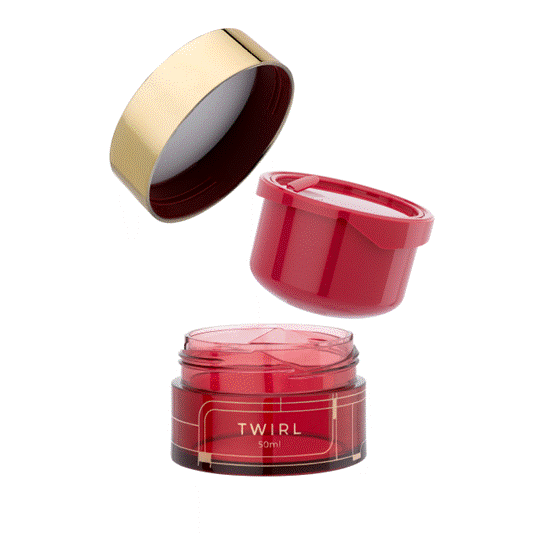
Albéa Endless Kiss mono-material lipstick and Twirl refillable jar
There is a trade-off. Minimum orders often start in the thousands, not the hundreds, so Albéa serves established or fast-scaling brands that need large volume plus bulletproof ESG reporting. If that matches your roadmap, their global horsepower is hard to match.
3. Quadpack – eco-luxury craftsmanship with B Corp backbone
Quadpack shows that you can package premium formulas in materials the planet can accept. The Barcelona-born supplier became a certified B Corporation in 2022 and renewed that badge in December 2025 with a higher score, reflecting progress on carbon cuts, fair sourcing, and community impact.
Material research is where Quadpack shines. A 2023 milestone with partner Sulapac produced a family of wood-based biocomposite jars that look luxe, behave like plastic, yet break down like sawdust. The newest 50 ml format handles water-based creams, bringing compostable packaging to mainstream skincare, according to Packaging Connections.
Woodacity adds another proof point. First launched in 2021, this patented line of mono-material wooden caps twists, clicks, or snaps without hidden plastic inserts. Built in Quadpack’s own FSC-powered factory, the closures blend tactile pleasure with single-material recyclability.

Quadpack Sulapac biocomposite jar and Woodacity wooden cap
Quadpack suits brands that value boutique artistry at mid-to-large volumes. You gain European design flair, Asia–EU production options, and a partner willing to publish life-cycle data alongside mood-board sketches. If your brief reads “premium, planet-positive, and a talking point on the shelf,” start here.
Quick comparison: which partner fits your launch?
All three companies earn near-perfect marks on sustainability, design creativity, and beauty expertise. The difference comes down to what you need most: speed with low MOQs, global scale, or a B Corp story that sells itself.
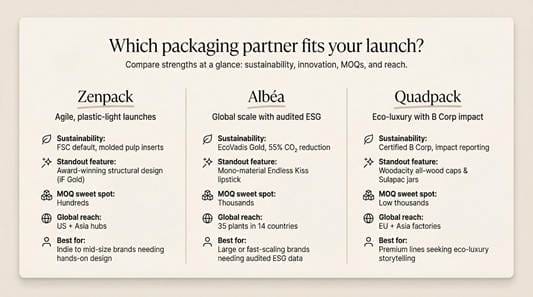
| Criteria | Zenpack | Albéa | Quadpack |
| Sustainability badge | FSC default, molded pulp | EcoVadis Gold, 55 percent CO₂ cut | Certified B Corp, annual impact report |
| Standout feature | iF Gold BIGFACE coffee packaging | Mono-material Endless Kiss lipstick | Woodacity all-wood cap & Sulapac jar |
| MOQ sweet spot | Hundreds | Thousands | Low thousands |
| Global reach | US + Asia hubs | 14 countries, 35 plants | EU + Asia factories |
| Best for | Indie to mid-size brands that want hands-on design | Large brands needing volume and audited ESG data | Premium lines seeking eco-luxury storytelling |
Tips for working with your packaging partner
Choosing a supplier is only the first step. The real work begins when the project kicks off. Use these proven moves to keep timelines tight, budgets steady, and sustainability claims solid.
Start with paperwork before prototypes. Ask for the supplier’s latest sustainability report, certification PDFs, and a sample bill of materials showing recycled content by percentage. A good partner can deliver these in an afternoon; a hesitant one signals a red flag.
Map your critical dates in reverse. Share launch day, retailer cut-off, and press-kit shipping windows, then ask the factory to propose milestones backward from there. Locking dates early prevents the dreaded “tooling delay” email that derails product drops.
Prototype for stress, not showroom. Insist on transit tests, humidity chambers, and real fill trials, especially for bio-based jars that can swell or warp. Catching issues at sample stage costs pennies compared with a recall.
Keep MOQ flexibility in writing. Whether you start at 1 000 units or 100 000, include a clause that allows volume shifts without punitive fees. Markets move fast; your packaging plan should too.
Verify every green claim. As Topfeelpack notes, without third-party validation, sustainability is “just talk.” Request cradle-to-gate LCA summaries or resin supplier certificates, then archive them for retailer reviews and future audits.
Conclusion
Use the grid as a shortcut: circle the row that matches your pain point, and the winning column will stand out. Then revisit that company’s profile for deeper detail.